UniWave Electric
When discussing electrical control systems, one might wonder, "what is the difference between a contactor and a relay?" Both devices play crucial roles, but they serve different purposes. A contactor is designed for high-power applications, while a relay typically handles lower power tasks. Understanding these distinctions can significantly enhance your electrical projects.
Contactor units can manage large currents, making them vital in industrial settings. They control motors and heavy machinery. Relays, on the other hand, are common in household devices. They help in activating smaller loads and are used in various automation systems.
Deciding between a contactor and a relay can be challenging. Each has unique features, yet they sometimes overlap in use. A clear grasp of their specifications can aid in making the right choice, leading to effective performance and longevity.
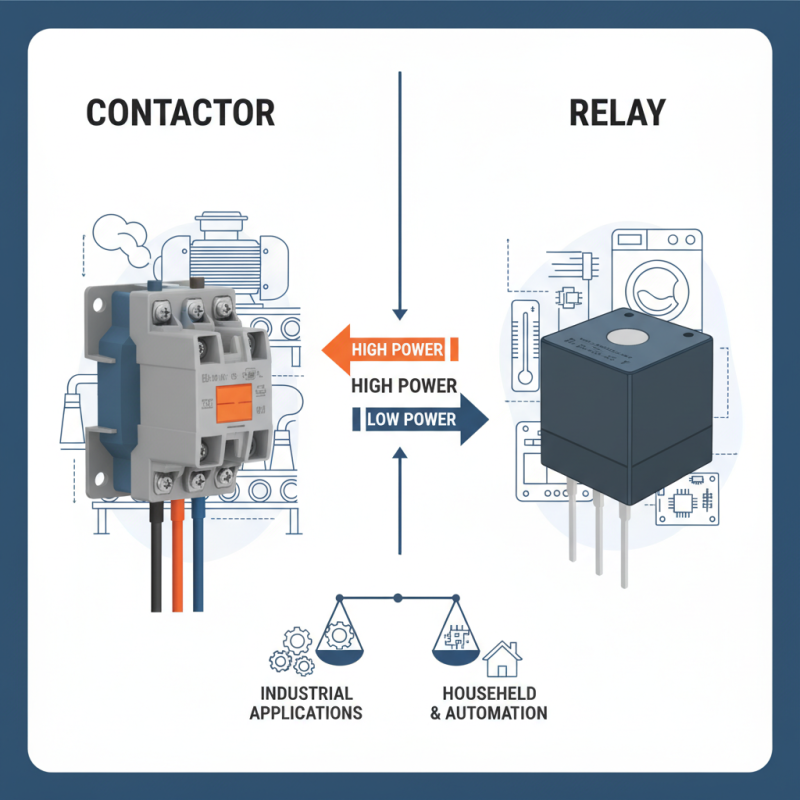
Contractors and relays are vital components in electrical systems. Understanding their differences can enhance system efficiency and safety. Contractors are high-power devices, mainly used for controlling large electrical loads. They enable power to be switched on and off across heavy machinery or lighting circuits. Research from the International Electrotechnical Commission indicates that contractors can manage loads up to 1,000 volts and several hundred amperes.
Relays, on the other hand, are designed for lower power loads. They serve to control circuits with smaller currents or voltages. Relays provide switching for signals rather than imposing heavy power loads. According to the Institute of Electrical and Electronics Engineers, relays are widely utilized in automation systems, protecting against overload situations by acting as safety nets.
Both devices feature electromagnetic coils and mechanical contacts. However, their operational characteristics differ significantly. An improperly selected device can lead to operational failures. Oversizing a relay can lead to slow response times. In contrast, undersized contractors may result in overheating. Understanding these nuances ensures optimal performance in electrical installations.
In industrial automation, contractors play a crucial role in controlling electrical loads. They act as a gateway, connecting an electrical circuit to the power source. A contactor opens or closes the circuit when the associated coil is energized. This operation ensures that heavy machinery can run safely and efficiently. The design of a contactor allows it to handle high current loads, making it essential for industrial applications.
Contractors are often used in motor control circuits. When employees start a machine, the contactor activates, allowing power to flow. This mechanism is vital for protecting circuits from overloads. However, misapplications can lead to circuit failures. For instance, incorrect coil voltage can cause a contactor to malfunction, risking equipment and safety. Regular inspection and maintenance are necessary to ensure reliability and functionality.
In contrast, relays are more suited for low-voltage applications. They control smaller electrical loads and often have lower current ratings. Although relays may seem simpler, their limited capacity makes them inadequate for heavy-duty operations. Understanding these differences can help engineers select the right device for their specific needs. Every automation system relies on the correct component to function optimally, and detailed knowledge is essential.
Relays play a crucial role in circuit control. They act as electrically operated switches. When a relay receives an input signal, it opens or closes a set of contacts. This action allows a low-power circuit to control a high-power circuit. Relays enhance safety and efficiency.
Understanding the operation mechanism of relays is essential. Inside, a relay has an electromagnet that attracts a metal armature. This armature either connects or disconnects the circuit. The process happens quickly, ensuring a fast response time. However, relays can wear out over time. The lifespan can vary based on usage and environmental factors.
In practical applications, relays are used in various systems. For instance, they are common in automotive and industrial applications. Sometimes, using relays can lead to unexpected issues. For example, if not rated properly, they may fail under heavy loads. Regular maintenance helps prevent these problems. Balancing performance and reliability is vital for long-term operations.
| Aspect | Contactor | Relay |
|---|---|---|
| Function | Used for switching larger loads | Used for switching smaller loads or signals |
| Current Rating | Capable of handling higher currents (up to 100A or more) | Typically handles lower currents (up to 20A) |
| Application | Used in industrial and high-power applications | Commonly used in control and automation circuits |
| Design | Larger, typically with multiple contacts | Smaller, usually with fewer contacts |
| Coil Voltage | Available in various coil voltages | Available in various coil voltages, often for specific signals |
| Operating Speed | Slower due to heavy-duty contacts | Faster operation due to lighter components |
| Common Types | Electromechanical, solid-state | Electromechanical, reed, solid-state |
When discussing the performance of contactors and relays, it's crucial to examine their functionality and application in electrical systems. Contactors are designed for high-voltage applications. They handle load switching tasks efficiently. In contrast, relays are often used for low-voltage control circuits. Their primary role is to amplify a weak signal. According to a recent industry report, nearly 60% of electrical failures are linked to improper switching devices. This highlights the importance of choosing the right component for each specific task.
Tips: Always review load specifications before selecting a device. The wrong choice may lead to overheating or failure.
Another aspect to consider is durability and switching speed. Contactors typically endure more cycles and deliver quicker performance under stress. A study from the Electrical Engineering Association shows that contactors can handle over 1 million cycles, while relays are limited to around 100,000 cycles. However, relays provide precise control and energy savings, especially in automation. The trade-off between efficiency and reliability requires careful assessment.
Tips: For automation setups, consider integrating both relays and contactors for optimal performance. Test at regular intervals to ensure reliability.
When installing contactors and relays, safety must be a priority. Both devices play vital roles in controlling electrical systems. However, their misuse can lead to dangerous situations. Reports indicate that nearly 30% of electrical failures stem from improper installation or malfunction of control devices. Awareness of these issues is crucial.
In typical industrial settings, contactors and relays can handle different loads. Contactors are designed for high-power applications. They switch larger currents safely. Relays, on the other hand, are often used for lower current applications. Miscalculating the load can lead to overheating or device failure. Regular inspections are essential. According to the National Fire Protection Association, overloaded circuits lead to about 80% of electrical fires. Safety measures such as circuit breakers and thermal protection help mitigate risks.
Additionally, environmental factors must be considered when choosing between the two. Humidity and dust can impair the function of relays. A recent study shows that 25% of relay failures are caused by environmental conditions. Proper housing and maintenance increase the lifespan of these components. Educating personnel on handling these devices can reduce accidents. Understanding the nuances of both contactors and relays is critical for safety in electrical installations.
: Contractors control electrical loads and connect circuits to power sources.
They open or close circuits when the coil is energized, allowing machinery to run safely.
Misapplications can lead to circuit failures and safety hazards, such as incorrect coil voltage.
They help ensure reliability and functionality, preventing unexpected equipment malfunctions.
Contractors handle high-power applications, while relays are suitable for low-voltage tasks.
Nearly 30% of electrical failures result from bad installations or device malfunctions.
Humidity and dust can impair relays, causing potential failures in operations.
Circuit breakers and thermal protection are essential for preventing overloaded circuits.
Educating staff on proper handling of devices reduces accidents and improves safety.
Correct component selection ensures system functionality and minimizes the risk of failure.
Understanding what is the difference between a contactor and a relay is crucial for those working with electrical systems. Contractors are primarily used in industrial automation for controlling high-power loads, operating through a robust mechanism that ensures reliability in switching large currents. In contrast, relays are utilized for lower power applications, providing circuit control and signal switching with greater sensitivity.
The operational mechanisms of contractors and relays differ significantly, reflecting their unique applications. A comparative analysis reveals that while both serve essential functions in electrical systems, contractors typically excel in performance regarding high current handling, while relays shine in precise control tasks. Safety considerations must also be taken into account when selecting between the two, as improper use can lead to hazardous situations in electrical installations.
