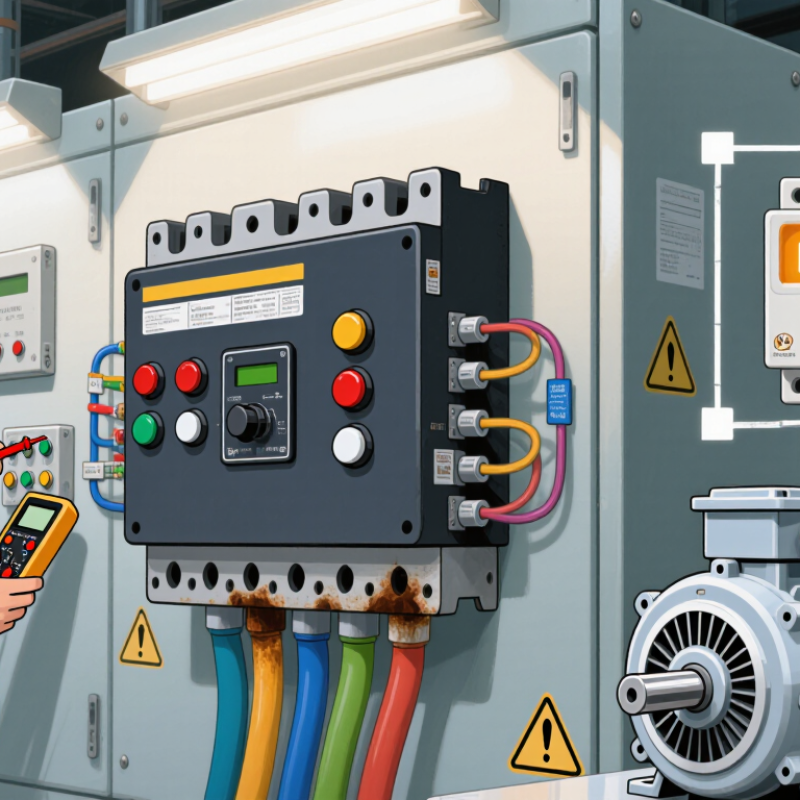
| Magnetic Starter Function |
Uses a contactor to switch power to a motor and an overload relay to help protect the motor from sustained overcurrent. |
Normal motor starting, stopping, or control operation. |
The contactor pulls in when the start command is given and drops out when control power is removed. |
Normal |
Confirm that the starter is correctly sized for the motor voltage, full-load current, and duty cycle. |
| Overload Relay Trip |
Responds to excessive motor current over a period of time. It is intended to protect against thermal stress rather than an instantaneous short circuit. |
Motor overload, blocked equipment, excessive mechanical load, or incorrect overload setting. |
The motor stops after running for a while, and the overload indicator or reset mechanism is activated. |
High |
Measure motor current on all phases, compare it with the motor nameplate full-load current, inspect the driven equipment, and verify the overload setting. |
| Short Circuit or Ground Fault |
A circuit breaker or fuse may interrupt a high-current fault faster than the overload relay can respond. |
Damaged insulation, loose wiring, moisture, or a component failure. |
The protective device trips immediately when the starter is energized or the motor is started. |
High |
Disconnect power and have a qualified person inspect conductors, terminals, the motor, and the starter before resetting the device. |
| Phase Loss |
One phase is missing or has a poor connection in a three-phase circuit, causing unbalanced current and motor heating. |
Blown fuse, loose terminal, damaged conductor, or an open contact. |
The motor may hum, run weakly, overheat, or trip the overload relay after a short operating period. |
High |
With appropriate test equipment and safe procedures, verify voltage phase-to-phase and inspect fuses, terminals, and contactor poles. |
| Voltage Imbalance |
Unequal phase voltage can produce a much larger current imbalance in a three-phase motor and increase heating. |
Utility supply problems, undersized conductors, loose connections, or uneven single-phase loading. |
Excessive vibration, unusual noise, elevated temperature, and repeated overload trips. |
High |
Measure supply voltage under load, correct connection problems, and investigate the upstream electrical supply if imbalance remains. |
| Low Control Voltage |
The contactor coil requires sufficient control voltage to remain engaged. |
Undersized control transformer, long control wiring, weak power supply, or a failing control circuit. |
The contactor chatters, drops out, or repeatedly starts and stops. |
Medium |
Measure control voltage at the coil while the starter is operating and inspect the transformer, switches, interlocks, and control wiring. |
| Contactor Chatter |
Rapid contactor movement can create heat, electrical arcing, and premature contact wear. |
Insufficient coil voltage, loose control connections, damaged coil, or mechanical obstruction. |
A buzzing or rattling sound, flickering motor operation, or visibly vibrating contacts. |
High |
Stop operation if severe chatter occurs; check coil voltage, terminal tightness, contact condition, and mechanical movement. |
| Mechanical Overload |
The motor draws more current when it must overcome excessive resistance or an abnormal load. |
Binding bearings, blocked pump or fan, jammed conveyor, misalignment, or excessive material load. |
Slow acceleration, increased noise, high motor temperature, and overload trips during operation. |
High |
Isolate the equipment according to the applicable safety procedure, then inspect shafts, belts, couplings, bearings, and the driven machine. |
| Incorrect Overload Setting |
An overload set too low may trip during normal operation; a setting too high can reduce motor protection. |
Setting does not match the motor nameplate current or the relay instructions. |
Trips occur under normal load, or the motor runs hotter than expected without timely protection. |
High |
Verify the motor nameplate data, starter configuration, overload class, and manufacturer instructions. Never increase the setting simply to stop nuisance trips. |
| Repeated Resetting |
Resetting restores operation temporarily but does not remove the underlying fault. |
Repeated overload, unresolved phase problem, deteriorating motor, or recurring control fault. |
The starter trips again soon after each reset. |
High |
Do not repeatedly reset the starter. Record when the trip occurs and arrange systematic electrical and mechanical troubleshooting. |
| Preventive Maintenance |
Routine inspection reduces nuisance trips and helps identify loose, worn, or overheated components. |
Dust, vibration, moisture, loose terminals, worn contacts, and poor ventilation. |
Discoloration, burnt odor, pitted contacts, loose wires, or abnormal operating noise. |
Routine |
Follow a documented maintenance schedule for cleaning, torque checks, thermal inspection, motor-current measurement, and functional testing. |
 UniWave Electric